Jiggling dead Tweets
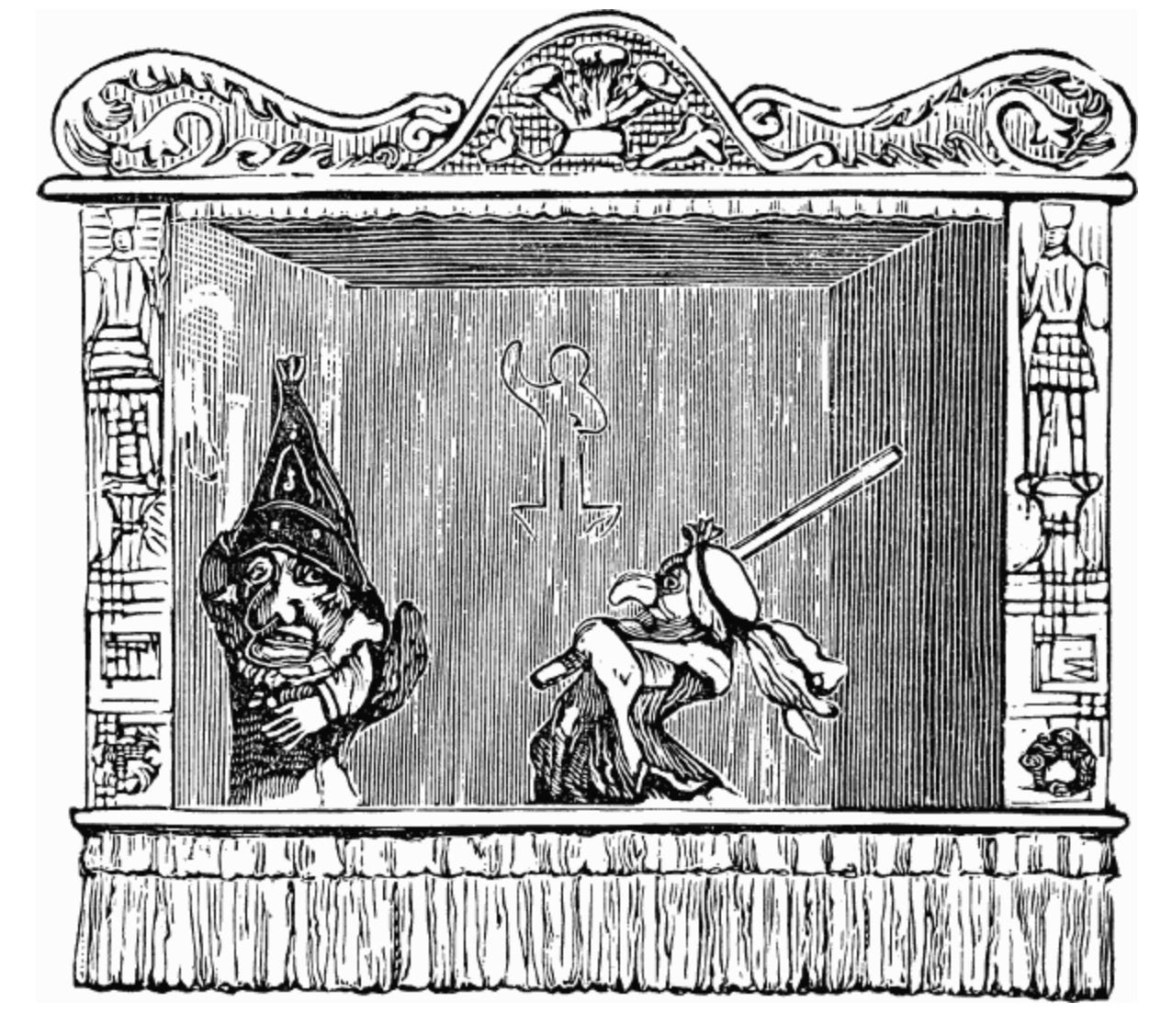
... like dead parrots for puppets in a Punch and Judy show for the kids to hate. A true tale of tracking Tweets until the showman comes out with his hands down.

Headings:
Introduction
For those who don’t know it, in 1969 the UK’s zany BBC TV show Monty Python aired their famous dead parrot sketch. Knowing my interest and saying kind things about my limited work, an online contact, Sol, sent me his full transcript of a long message he wrote for his private family message group. Sol changed his and his family’s real names and some identifiable details. But otherwise, he said, this is true. It has the ring of truth. Even if Sol has made it up, this is a compelling insider’s story.
This is a long read. Sol asked me not to edit it down. He said repetition was needed. I’ve done some light editing, added a few effects of my own, the images and a few more linked references. He approves this combined version. I pointed out that I don’t have many followers. Sol said some loyalty was due. I am honoured and grateful to be doing this. I believe and hope that the result is worthy of a wide audience which I promised to pursue. Sol and I acknowledge the sustained private help from family and friends and the integrity-saving public light shone, for us who struggle in the dark, by those who lead the debates in the open. Many of the torch bearers appear in our list of references at the end. See our important code of confidentiality and privacy there too.
The family. Sol’s wife is Mira. Their three adult children are Lars, Shea and Beck (the quiet one). Each of them have older children at home. Two of those are transgender. Sol and Mira are sex realists who care about trans and gender diverse kids especially. Shea is very pro-trans activist and other causes too, Lars is fairly pro-trans, Beck quietly pro-trans.
The dead parrot had come up at the end of a prolonged dispute about an old Tweet and ReTweet. At the prospect of even more of that, the serious joke was that it would be like jiggling a dead parrot as if for a Punch and Judy show for kids who love to hate a baddy. Sol liked this metaphor as a way into expanding an idea to examine the one and then a second Tweet as cases of “jiggling a dead parrot”. Sol’s hope, for his family and now for the rest of us, is that a touch of humour might help us all to see more accurately and to defuse this modern online form of demonising that he compares to witch-hunts of long ago.
Whats up? …
[Sol’s long message to his family starts like this:] “Our buzzing exchanges this week between the five of us have been great. After the prolonged contentious analysis of one of Mira’s past ReTweets of someone else’s horrendous transphobic (or maybe it wasn’t?) Tweet, and then another round on what some quotation marks meant, Lars then asked for yet more discussion of the ReTweeted Tweet. That’s when I said he must be joking, that that Tweet was a dead parrot etc [see above]. We had come, I thought, to a 100% agreement about the main thing. The agreement was that all five of us are allies of the authentic pro-trans community who utterly reject bad actors like those the disputed Tweet linked to the trans “community” and to Jeffrey Epstein’s gang. I don’t know how Lars can disagree with that, but he said he didn’t agree.
“Our lengthy discussion [the five of us] of how transphobic or not the Tweet was and how transphobic or not that made Mira for ReTweeting it, included our [the two of us] repeated expressed actual views. Our actual views were certainly not well conveyed by the ReTweeted Tweet. I was wondering why anyone would need to, let alone be keen to, revive the dead Tweet. To me, it would be far more important that our fresh actual views were clear. At that point, along came an exchange about the second Tweet about a joyful gay couple’s new surrogate baby. This time the sin was homophobia. Lars, urged Mira to show more empathy for select groups like this gay couple. Mira pointed out how some select groups get compulsory empathy and kindness while others, women and old folk for example, are to get none. Or worse: they get gleeful antipathy and unkindness.
“If Mira complains about that, Shea’s charge is that she is playing the victim. To me that’s amusing. The whole kindness culture is now a competition for which identity groups get medals in the Victim Olympics. Mira is not “identifying as” a victim; she actually is a victim of Shea’s verbal abuse. What’s real matters. The other side of this coin is that there are many individuals trapped in medal-winning identity groups who object to having their power to think and act independently over-ridden by for-your-own-goodies. They object to being classed as victims as the group waves its medal and the progress flag flutters up the Victim Olympics flagpole.
… It’s selective empathy
[Sol had read my Substack article, Learning from What-a-Mess. So Sol next says:] “In all of that, I heard “selective empathy” calling to us. Nick Child introduced me to Dane Madore’s ideas that include selective empathy and other concepts. Selective empathy shows most obviously in how those who profess an utter virtuous kindness for some seem to have no kindness left for anyone else. The reverse even: unkind antipathy. Note that this antipathy isn’t honoured with a “phobia” label. Being unkind is not frowned on when delivered to a lower class of vulnerable people. What’s more, unkindness is actually justified against a lower class if they have shown unkindness to the higher class of identity victim group. The general rule seems to be that if you don’t support my kindly cause, then you deserve to be treated unkindly.
“Mira pointed this out between us here. There has been long-sustained unkindness to us in the name of the special need for what is presumed to be utter kindness toward transgender people. Yet, Lars, you have also pointed out that even sorry criminals, like Isla Bryson, deserve care. You’re right: billions of people on earth each deserve someone’s kindly care, even or especially the victims and the vulnerable. Isla Bryson is to be treated kindly; but not us your old folk? How can that be?
“Empathy is close to kindness. The idea of “selective empathy” is harder to get a hold of than kindness. Following from what Nick learned from What-a-Mess, I think it’s worth expanding on this further.
“Humans have evolved for a very limited empathy: for their own self, for their family and tribe. It is impossible to be effectively empathetic toward billions of people. So a new world and a global village of over eight billions means limiting our small supply of effective empathy. We all have to be selective, as What-a-Mess did when ridding the world of ants, and take up a more limited target of one or a few groups. Then our once grandly sacred, now our more secular pursuit of one good cause bumps up against another good cause. Disputes inevitably arise, as it still does for tribes.
“For some decades, the world has been strangely quiet about the real world’s real problems of poverty and social class. Certainly neither old-fashioned material socialism nor communism are on people’s lips now. Poverty and severe inequality has been put in the too-difficult basket.
Cultural socialism and empathy
“As you said, Shea, all of us five yearn for a return to socialism. I’d say that must mean material socialism that produces real practical solutions not just signalling some virtuous views about poverty and class. Where did material socialism come from? What replaced it? It’s the same answer. Centuries of religion-based culture in the West morphed into secular beliefs. On their own those are best called: cultural socialism. That’s socialism that’s rather detached from any material change or what’s actually delivered on the ground. Cultural socialism is the West’s dominant culture now. Strangely it’s a culture that, in the US at least, most benefits the well off who are also those most vocal about the minorities who don’t actually benefit.
“But the world has indeed reaped huge benefits from the values of cultural socialism. Alongside major global problems, the fine old religious values remain: liberalism, egalitarianism and humanitarianism. Refugees only head where those values survive. To those broad values has been added a more problematic aim: equal outcomes and harm protection (significantly now including emotional safety) for historically disadvantaged groups. “Emotional safety” means that key words become more emotive and harmful than fists and swords do. While “equal outcomes” has mixed benefits as not everyone can be “more equal than others”. Cultural socialism, with the extra aim, is what “everyone” now believes. In recent decades, that is what has got pushed much harder for a few selected groups especially.
“Led and shaped by the US civil (race) rights movement in the 1960s three identity groups became a “sacred” trio of historically disadvantaged groups: race, gender and sexuality. Many sociologists and others have written — yes, Shea, books; sorry about that! — on how a really intense cultural focus has built up for this top trio. Let’s call that an extreme selective empathy. It goes with its opposite: less empathy or selective antipathy for other groups. Many writers show how this, more extreme crusading version of an already widely accepted kindly cultural socialism, has so many standard features of religions, but without the supernatural gods. They show it very much as a secular form of fundamentalist religion presuming authority to do selectively kind things for some groups and illiberal unkind things to lower rated groups and any who don’t agree. The passionate fundamentalist beliefs and activism can gather great social power.
“Leaving the secular religion idea aside, for now let’s stick with selective empathy, with kindness and unkindness like we saw with What-a-Mess and the ants. Here’s an example of ordinary empathy and lack of empathy:
“Mira got knocked over by a bike a while back. Badly bruised, but it could’ve been far worse. Now, I’m 100% certain that you three, as you’ve promised to and done for us and others, would have given the same instant empathy and help that lots of passers-by did for someone who’d been knocked down, sitting dazed on the kerb to recover as Mira was. Eira, albeit with (you say) only her lowly cupboard-love kindness for us her grandparents, Eira showed the kind of empathy normally kind people have shown after the accident. Eira listened and asked kind questions like “Was it sore? Did you cry?” But not you, our grown-up children, not you. It feels very much as if Mira — an older lady, your mother, a female — Mira’s not selected for your empathy. We covered that earlier. It’s OK, don’t worry yourselves: we understand selective empathy. We’ve long got used to a low level of kindly interest from you three. It’s not hard to see a rationale for your low empathy. So let’s continue …
Tracking a second Tweet
“Back to the serious joke about jiggling a dead Tweet like it was a dead parrot and about your evident top priority, the two of you guys (Beck was quiet as usual), to search, I suggested, for more dead parrots and dead Tweets to jiggle as if they’re really of utmost importance. It’s like you’re running a Punch and Judy show and you need some puppets for the crowd to yell their hate at. As you probably don’t like that idea, let’s test it further. Let’s track the homophobic Tweet, the joyful gay couple and their baby, and see if it fits the jiggling dead parrot theory.
“When I mentioned that the author of the book that I was reading (on assisted death, by the way) just happened to be the famous “transphobic witch”: Kathleen Stock (KS), you, Shea, as I had predicted, took off in your usual way. A double derailment of my post on the importance to me of books, important also to any field of serious knowledge. Hmm. You mocked me as “admitting” to my reading preferences and I replied that years of telling you that I do that meant that this was not some new kind of sin to confess. I didn’t pick up then how you’d doubly diverted and cancelled my main point (about books and the likes of KS’s books too). You proved my prediction instead. I also didn’t realise until later that your selected antipathy screen-shot with your anti-KS comment then set off the longer thread picked up by Lars and Mira. I note you’d kept the KS Tweet from years ago. And that the screen-shot wasn’t because Mira nor I had ReTweeted it. So this was a fresh use of a long dead Tweet to demonise KS alone.
“I do agree with you, Shea and Lars, that in her Tweet KS mocks the gay couple. On its own, that makes it “homophobic” — given the odd new use of “phobia” to mean just “antipathy” or “unkind” with an extra slur of implied naughtiness. Beck wasn’t sure; she sees Lux as not in the same boat since s/he’s a tomboy attracted to girls and thinking of transitioning to identify as a boy. I note again that “antipathy” is a useful pair to its opposite “empathy”. So let’s ask more about what exactly KS’s antipathetic sin or crime is in her homophobic Tweet?
“Basically, it amounts to KS sharing an unkind thought on a public platform with pals where the likes of you, Shea, must also have been waiting to pounce on anything less than kindly empathetic thoughts on select identity groups. Leaving aside cute cats, I’d reckon that a great many of all the world’s social media posts about anything are a bit unkind and antipathetic. And even when extremely unkind foul abuse and extreme labels are used, as you do with us, Shea, it’s not against the law. We’re victims but not victims of a crime. The UK’s covert non-crime hate incident approach proved, as many had predicted, unworkably useless and has been withdrawn. Anyway, for this Tweet, KS seems to forget that you, the pouncers, are there as she chats in an impromptu, among-friends sort of way. She uses the mockery that did — does still with a jiggled dead parrot — make it unkind.
“I’d guess that KS would agree on that. It’s also not, not on its own anyway, a well considered or impartial message. Posting it was not wise either given the informality in a public controversial space. Instead of a screen-shot, someone could have, maybe they did, challenge her on her Tweet and her transphobic tone. Maybe KS apologised or explained or corrected what she said or should have said. Or maybe she would have made her homophobic sins even worse. As our resident archivist, Shea, how about going back to find out if anyone did take KS up on it then? Did you reply perhaps? Or were you just collecting dead Tweets for future use?
“So, alongside those views about KS’s homophobic Tweet, I can also agree with what Mira is pointing out about our freedom to say things, even if they’re in poor taste or unkind or wrong or need to be challenged or put right. That’s what two-way free expression is for. In this case, without that sacred trio thing going on, there is no more reason to avoid saying something a bit critical or unkind about a gay couple than there is in 1000s of other family situations where people make comments on the qualities of families, of parents with their children. This kind of unguarded chat is as common as muck everywhere and especially in any social or public media coverage.
“So how come this homophobic one from KS gets it in the neck? Oh yeah: it’s in the sacred trio of historically marginalised identity groups and a pouncer was waiting to pounce on it. Plus KS is already a confirmed transphobic demon. But unkind posts are very common and they’re not against the laws of the UK. Did you, Shea, or anyone else report KS to the police for this Tweet?
Evil but not illegal
“So my next question is: if the law of the land isn’t being broken, whose imperiously applied laws or rules are being broken by KS here? Who or what drives this dogged search for dead parrots to jiggle? The question with the jiggling dead parrot theory is basic: Why do you, Shea or anyone, go to the extent of counting what people do and don’t Tweet about (as you have with us) and keeping as you do a large archive of saved sinful posts from which you can conjure one up for any occasion that needs a dead parrot jiggled? It can’t be just for the purpose of diverting from questions you don’t like. And we see it can’t be because it’s against UK laws.
“Social media platforms famously invite every kind of serious or informal chatter. Free for us the users, they earn for their capitalist owners billions of dosh from the millions of users who pay up freely in our avid attention to scroll on screens and apps that help to raise the capitalist his billions. (Pronoun advised there.) Algorithms are set to breed unkind posts to attract more user time on their platforms. But our ancient continuing culture and laws of free expression allow those who want to scroll and post to do so freely and addictively. Very few Tweeters or Tweets, even those of trolls, rate as criminally harassing, harmful or risky in the real world. Have you thought of reporting Mira or me for private or public hate crime, Shea? When NCHIs were the rage, why didn’t you? I’d have loved to have seen what happened if you had.
“The same vulnerability to gossip, social pressure, fake news, offence and occasionally vicious campaigns happened long before the internet. With the internet it has been virally enabled with the elephantine benefit or downside that, unlike ordinary gossip, the internet (and the likes of you, Shea) never forgets. The police use it as evidence too. But saying unkind things is legal even if some want it to be a selectively heinous sin.
“If it’s legal for anyone to Tweet, RT or whatever and say what we like online, it can’t be that you, Shea, are motivated by UK law to do a community cop thing. You’ve harassed relentlessly but no citizen arrests yet? So what drives the likes of you? What law do you take as authority for your imperious majesty that demands the righteous hunt for evil demons? What secular god gives you licence to be so viciously sure you can go beyond the laws of the land and impose, in public and in private, your self-appointed role and rules on who are the bigots, fascists etc who you then decide must be excluded from debates?
“That’s my question. Who’s law are you under Shea? Do you draw your presumption of superior ethical authority from some formal or informal network or some special holy website? Or is it just your own personal creation? Maybe you’re just “that man behind the curtain” in the Wizard of Oz, jiggling his levers to create and keep up his fake powers?
Imperious majesty with no authority? Two examples.
“Obviously we can see many wider groups behind you feeding into all the same kinds of issues as you do. The informal networks and levers behind you are not behind any curtains. They’re in the open. Success did come from covert operations and a scary injunction of "no debate”. But debate there most certainly is now. Yes, it is quite natural for all of us to drift or join in with the group that seems sympathetic to our own interests and good causes. And so off you and we go and on we all go. Pre- or post-internet, humans are free to go beyond the actual law of the land. Freeing people to live their lives as they want, within boundaries that protect everyone’s right to live freely: that’s what the law is meant to do. That freedom is usually innocuous and useful. But it also frees some to go beyond protests and disputes to build social influence that empowers a voluntary group for good causes into harmful ways. People can do wrong things for the right reasons, as they say.
“There have probably been as many state empowered witch hunts as there are states to host them. To show how far voluntary, not illegal, social movements can go, here’s two famous US pre-internet witch-hunts. One’s against witches, the other against communists.
“First the Salem Witch Trials of 1692-93 followed an epidemic of accusations. There was high anxiety in the pre-enlightenment gossip-soaked communities of Essex county ravaged by years of messy frontier wars. The allegations started with four young girls claiming that some women had, as spectres, caused them fits and “afflictions”. This spiralled into so many court cases and convictions that people realised unusually quickly that something was not right. But not before 200 women (and some men) were accused, 30 found guilty, 19 hanged with other awful fates for others. Traumatic fear and antipathy in a God-fearing culture that believed in witches stirred up wholesale mayhem and sanctioned innocents put to death. It stopped when the accusations and flawed justice were found embarrassing. Note to the future: witch-hunts depend on gullibility. We don’t believe in witches now, but other spectres of hidden fear, antipathy and demonising are alive and well and visiting us.
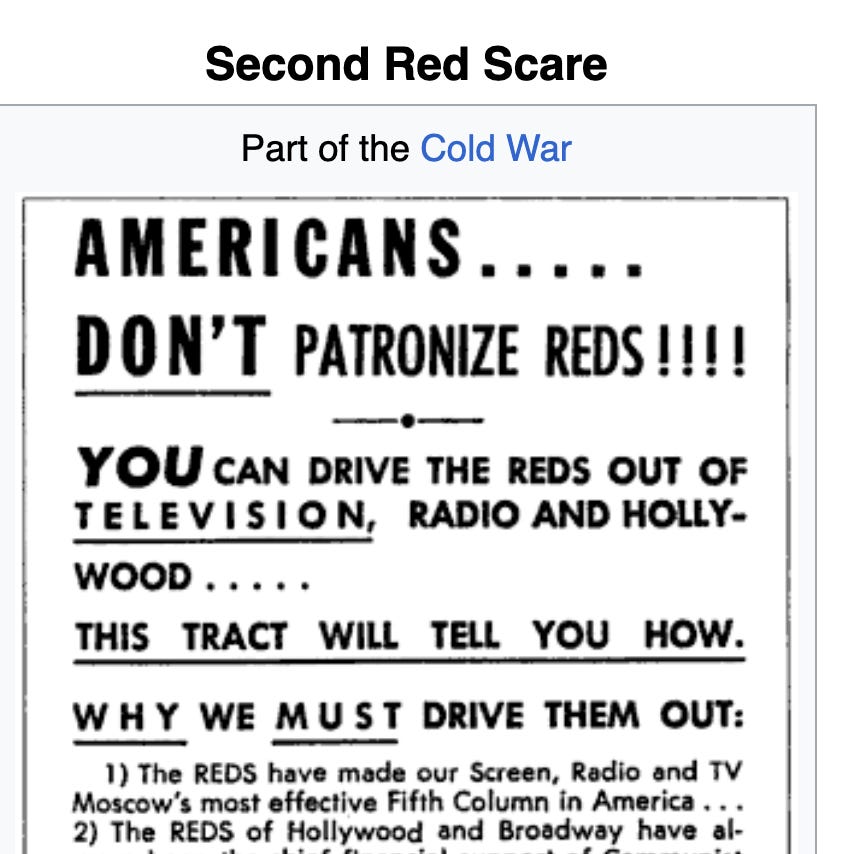
“Second, within the cold war and a wider Red Scare across the US in the late 1940s and 50s, Joe McCarthy led the targeted demonising of those he alleged were subversive “Red” Hollywood actors. Below is a flier from the 1950s from Wikipedia. Later he set about ridding the army of Reds too, but he was brought down in front of huge crowds and TV cameras. They saw through his unforgivably cruel witch-hunt: “Have you no sense of decency sir?”
Who’s behind Shea’s majesty?
“So now, back to us and our family discussions and tracking KS’s Tweet. My question remains. From where do the likes of you, Shea, get any authority for such imperious majesty?
“I see no other power than present-day voluntary, passionate, fundamentalist, beyond the law but entirely legal opinion and cultural forces. These must be the fuel for the likes of you, Shea, being so pumped up with yourselves and your selected good causes. Mira and I have seen it in recent years of relentless antipathy and demonising of us and the likes of us.
“Let’s leave aside, Shea, how far your cause and your manners are from a secular religion with sacred identity groups of race, gender and sexuality. Let’s leave aside even the witch-hunt pattern, even though demonising people is evident. Let’s stick to the simpler notion of selective empathy for some identity groups and antipathy for others, sometimes even gleeful antipathy as if it’s what’s due for evil people. Selective empathy groups bring the potential for conflict and dispute between opposing righteously fuelled and revved up activists. Actually, those activist groups are often more extreme in their behaviour than even highly fundamentalist religions are. Perhaps secular religions have to work harder as they don’t have a heaven in mind.
Two sets of different manners: the Mods and the Exs
“Put simply, there are two kinds of good cause (or bad cause) groups who seem much the same but have different manners. It’s important to note that the manners of an extreme version of roughly the same good cause are significantly different, yet they’re not different in their manners to an extreme version of an opposing good cause. This difference of manners within and also on opposing sides makes things all more confusing. Here are some evident differences between the manners of a more moderate liberal (Mod) and the manners of a more extreme illiberal (Ex) kind of activist group:
The more moderate groups (Mods) do not try to erase the right of more extreme groups (Exs) to hold their opinions;
Moderates may hold passionately strong, selected empathy, views that Extremes don’t like, but Mods try not to act and talk as if they are self-appointed imperious high judge jury and executioner over the Exs;
Mods are not intent on silencing Exs nor trying to hound them in private and public until they stop using social media;
Valuing practical action over mean words leads to Mods priority to stick with their friends and family despite conflicts of opinion or of politics, race or religion: Mods will socialise, be responsible for the family “kinkeeping” and the care of their ill or old folk. The growing trend now is for Exs to attack and cut off relationships as a result of key disagreements over words which may then exclude social contact or care as well.
Exs are impatient to pursue their aim of welcoming any trans person on their way; they set aside Mods’ concerns for the wisdom, safety, science and ethics of what may be permanent life-changing decisions. Mods concern is for informed decision-making to avoid mistakes and future regret. For example, with children, Mods and Exs unite in concern for gender transitioners. Exs want to ensure social affirmation and whatever follows; Mods too want to ensure a person’s happiness, health and life. But Mods want reliable evidence for well-informed decision-making. Exs and Mods fall out furiously with each other’s valid concerns for trans people — let’s rush on versus hang on a minute. Discuss this example: the 20 mph speed limit.
We all suffer from confirmation bias; it comes with our natural tribal tendency for selective empathy. But Mods do try to avoid the Exs’ degree of flagrant ignorance of principled reason: eg logically incoherent changes to our language; eg forcing an actual spectrum of race to be a binary, and an actual binary of sex to be a spectrum, using a false logic equivalent to proving human beings are on a spectrum of having between 0 ←→ 2 legs rather than look for what went wrong for those individual cases who have just one or none or half legs: these are the famous exceptions that prove the defining two legs rule.
And Mods try to focus on objective evidence instead of brazenly finding or faking facts to confirm their own bias: eg trying and failing to prove the plainly unfair notion that biological males are, as a category, fair players to be included with women in sports.
Mods are not into archiving dead Tweets and posts to demonise others in public and private nor to stir up others, even your own friends and family, to demonise each other;
With the milder KS kind of exception, Mods generally aim to be far more respectful and kind — or at least less unkind — towards Exs, than Exs are to Mods with their often abusive name-calling and ad hominem or other issue-avoidant ways of debating. Anyway Mira and I try to talk respectfully, even if our views are taken as inherently unkind, evil and “phobic”;
Even though Mods are fired up, just like Exs, and Mods feel as upset and concerned as Exs for the people they’ve selected for their empathy, Mods do not resort to Exs’ extreme fundamentalist witch-hunt kind of talk and behaviour;
A sense of humour is hard for anyone caught in our culture wars; both Mods and Exs are serious and passionate for their good causes. But it’s harder to imagine any Ex finding anything to smile about when they’re on a crusade.
As we’ve seen in 5. above, a Mod’s selective empathy group may be the same historically disadvantaged minority as are also in an Exs’ selective empathy group. So then Mods and Exs can still heatedly dispute which approach is best for the same shared group;
To repeat this important point another way, there can be more extreme illiberal versions of quite similar moderate liberal groups. Both Mod and Ex versions may have similar views and aims about what should be done. But the manners of the illiberal Exs will more closely match the manners of the illiberal Exs of an opposing group. An even more polarised battle is likely.
Mods may be, as Exs are, caught up in extreme selective empathy, but they work as hard as possible to keep to a broader liberal principle of universal fairness and kindness as far as is humanly reasonable, for any and all humans and especially for historically disadvantaged groups:
“So for moderate Mods and extreme Exs groups, the ways of the one kind of selective empathy group can be strikingly different to the ways of the other kind of group. Read more on the important distinction between Mods and Exs, on liberal and illiberal, here.
A caveat: behaviour vs beliefs
And now, after writing and listing all of this, an important caveat. Liberal civil Mods can still be shocked to their bones as they realise how illiberal and uncivil Exs can be as they cut Mods down. It comes down to a street fight the police aren’t interested in. It’s a vital struggle over the cross purposes of those who prioritise and collaborate pragmatically through (real world and social) behaviour — “manners” as I’ve been calling it — and those who prioritise and fight over (ideological and mental) beliefs. This ethical debate also bothered the early Christian church: some focused on orthopraxy (right action) and others on orthodoxy (right belief).
Liberal Mods hold that behaviour matters most. Mods hold that a society is tolerant and constructive when everyone is legally and culturally free to believe what they want to and free to behave how they want to within democratic laws and civil limits. Mods hold that resolving differences civilly requires principled reason, objective evidence, engaged discussion and robust debate. A Mod is open to this process and its temperance of undue grandiosity. Beliefs can be treated lightly because, in reality, any individual’s beliefs are a very long way off being realised in the policies of the real world. It’s a long process before ideas actually turn into collective action. For Mods, kindness may require facing the cruel truth.
Illiberal Exs hold that beliefs matter most. Based (illogically) in a real-world-denying philosophy, an Ex’s certainty is that their beliefs are pure, good, right and kind and that any other beliefs are bad. Any who signal less than enthusiasm, even pausing as a Mod will do, means they are evil not just bad. How does an Ex know that a Mod or opponent holds evil beliefs? Minimal signs are enough: their Tweet, their pause or questions, or quickest to take the word of others like histrionic girls in the Salem court room in 1692, or just our dead Tweets in 2026. An Ex doesn’t need to bother about a person’s actual beliefs to determine that they’re bad and that damnation and erasure are in order. Forgetting the long process before a belief becomes policy, the Ex’s mental world allows the magical thinking of a toddler or a dream. An individual is treated as if they have the single-handed power to turn on operational public policy the very next day. Exs’ beliefs are secular but their mentality is grandiose. It’s as if humans can tap into supernatural powers — Mods from Satan, Exs from God. Or band together with others who share the Ex’s belief or who are too scared to disagree, creating a collective grandiosity like that of cults and institutionalised monomania. So ridding the world of the one evil ant is required; going for the kill is urgent. It’s too late for diplomacy; and discussion isn’t in an Ex’s skill set. Unkindly cutting down an evil opponent or a questioning Mod is a kindly Ex’s civic duty. For an Ex, a good kind cause justifies sustained cruelty to dissidents.
So Shea …
“All these years of dogged stormy oceanic work, relentless 100% kindness to your sacred selected empathy groups and 100% unkindness for us and others, all the time shipping water into our precious family boat. Obscured by the Ex vs Mod battle, in fact we do share one good cause group: the children and adults involved in gender transition including your children, our grandchildren, Zia and Lux. Our own dispute, I say, is more Exs vs Mods not about any sinful “phobias”. Vast amounts of your time and life in recent years have been consumed in promoting this extreme good cause and in calling on us to spend large amounts of our time and life trying to work out what to say or do for our son, the extreme activist. All poured in for … well, for what? Apart from the years of miserable battling, now spread to the wider family, who exactly have you actually influenced? And influenced to do what? It was your doing that we got active in this, got us more “politicised” but in an opposite direction. What if you’ve turned off as many people by your extreme activism as you’ve turned on to your cause?
“Watching one Tweet and then tracking a second one here adds some confirmation to what it is you prioritise. You are keen on jiggling dead Tweets as if they’re dead parrots in a Punch and Judy show for the kids who love to hate a baddy. And now it seems, poor Lars, carrying a full time job and his own family challenges, is caught between your influence, and his kids who we find are also keen junior activists, while we oldies are in a third corner. Wow! If anyone ever needed some empathy, Lars, it’s you! Being this brutally honest here feels hopeful to me after years of your brutal words to us, Shea. So far, Lars has been a Mod not an Ex. May that continue.
“And why not let’s all become Mods? We can still campaign for the same things we already do, but we can behave like Mods not like Exs? How about that?
To conclude
“We’re in a tiny, private, local, family tea cup of a boat on an ocean of demonic storms. That great storm has shipped into our tea-cup. If you’re not driven, Shea, by a secular god-like authority that empowers you to promote a fundamentalist cause in an extreme way, then you’ve got some explaining to do for your self-generated imperiously majestic way that you do your thing. It’s rocking the boat when we could be heading for harbour. To us you seem disturbed and you’re disturbing. We feel sympathy and empathy for you for that, Shea.
“To finish up, I’ve tested out the jiggling dead parrots theory. I think it fits. Almost certainly, you’ll not be persuaded. You’ll probably do your usual to this, Shea, machine-gunning us down. But you’ll not kill me off nor my fine batch of metaphors either! Instead of the really grim ways to frame this grim business, I hope the key idea of selective empathy and antipathy for identity groups helps more constructive understanding. And the playful metaphors bring back some humour and light. I appreciate and value your obvious engagement in our family group and your lack of indifference, as someone recently described it.
“The metaphors are: What-a-Mess The Good and his ants; the family crew in a boat on rough seas working to stay afloat and find a calmer harbour; the jiggling dead parrots for a Punch and Judy show; and the Wizard of Oz behind his curtain. The historical examples I’ve used are: the Salem witch trials and the McCarthy hunt for Reds.
[Sol leaves us with this “I have a dream” ending:] “I end feeling confident and free like I haven’t for years. It feels like I’m talking warmly through a locked door to someone held hostage or to the hostage-taker or to both. My real hope is not to break down doors, but to draw back the curtain. Or for you to come out from the Punch and Judy box with your hands down to release the dead parrot. So we can be free for even better campaigning for select good causes, free for more fruitful discussion and debate. We can get back our family’s humanity, honesty, happiness and humour. That can only come from meeting the real puppeteer, from greeting the man behind the curtain instead of the fake Wizard of Oz.” [End]
Nick here now: My thanks and all best wishes go to Sol and all his family for providing this window into this true family story. Best wishes too for countless other families privately struggling like we have. Thanks for the great references and hotlinks. I believe that Jiggling dead Tweets educates us all. Sol and I hope this story may inspire and help other families facing similar challenges to keep their boat afloat in stormy seas while they steer for a safe harbour.
Engraving by George Cruickshank in Prof WJ Judd’s “The tragical acts or comical tragedies of Punch and Judy” 1879. Online transcription by Project Gutenberg eBook
The References + Links
Cinemathia: Monty Python’s Dead Parrot Sketch (2.58 min YouTube video clip)
Wikipedia: Progress flag
Nick Child (2026) Learning from What-a-Mess: A dogged tale from Frank Muir with good ideas from a great Dane.
Frank Muir (1978) What-a-Mess, the good. Illustrated by Joseph Wright
Dane Madore (2026) Defusing Ideas > Observatory > Selective Empathy and Collective Grandiosity
Wikipedia: Isla Bryson case
Eric Kaufman (2024) TABOO: How making race sacred produced a cultural revolution
George Orwell (1945) Animal Farm
Musa al-Gharbi (2024) We Have Never Been Woke: The cultural contradictions of a new elite
Kathleen Stock (2006 - 2026) Books
Gov.UK (2026) “NCHIs to be scrapped to end policing of petty squabbles …”
David Cartwright ( The Age of Addiction. Chapter 7. Limbic capitalism has been driving addiction for 100s of years
Jonathan Haidt (2026) Treasure Your Attention: My commencement address to the NYU Class of 2026
Clive Hamilton (2026) Dodgy pronouns and phantom identities … “Foucault in action”
Andrew Doyle (2025) The end of ‘non-crime hate incidents’
Grant Lewis: The Wizard of Oz: Pay no attention. (1.50 min YouTube video clip)
James Kirkup (2019) The document that reveals the remarkable tactics of trans lobbyists
Nick Child (2026) There’s Not No Debate Now: Google AI finds a long list of groups who take issue with trans activists
Wikipedia: The Salem Witch-Trials
Mary Beth Norton (2002) In The Devil’s Snare: The Salem witchcraft crisis of 1692
Wikipedia: McCarthyism
American Experience (2020) “Have You No Decency?” McCarthy (5.45 min YouTube video)
Michael Foran and Julie Bindell (2026) Looniversity challenge! (With videos of the disruption)
Rachel Haack (2026) That was your job
James Meacham (2026) The Beetle, The Beard, and the Biological Kind: A Philosophical Critique of Gender Identity. Also: orthodoxy vs orthopraxy.
Richard Dawkins (2024) Race is a spectrum. Sex is pretty damn binary
Steve Stewart-Williams & Yascha Mounck (2026) Fighting the good fight over sex differences
International Olympic Committee (2026) Policy on the Protection of the Female (Women’s) Category in Olympic Sport
Helen Pluckrose (2026) My Talk to an Italian LGBT Organisation on Liberalism and LGBT Rights
Steven Hassan (… 2026) Freedom of Mind > Influence Continuum > BITE Model
Jonathan Haidt (2021) Monomania is illiberal and stupefying.
Joshua Coleman (2026) “I didn’t raise my child to be so disrespectful!”: No you didn’t
Martin Luther King Jr (1963) I have a dream