Learning from What-a-Mess
A dogged tale from Frank Muir with good ideas from a great Dane.

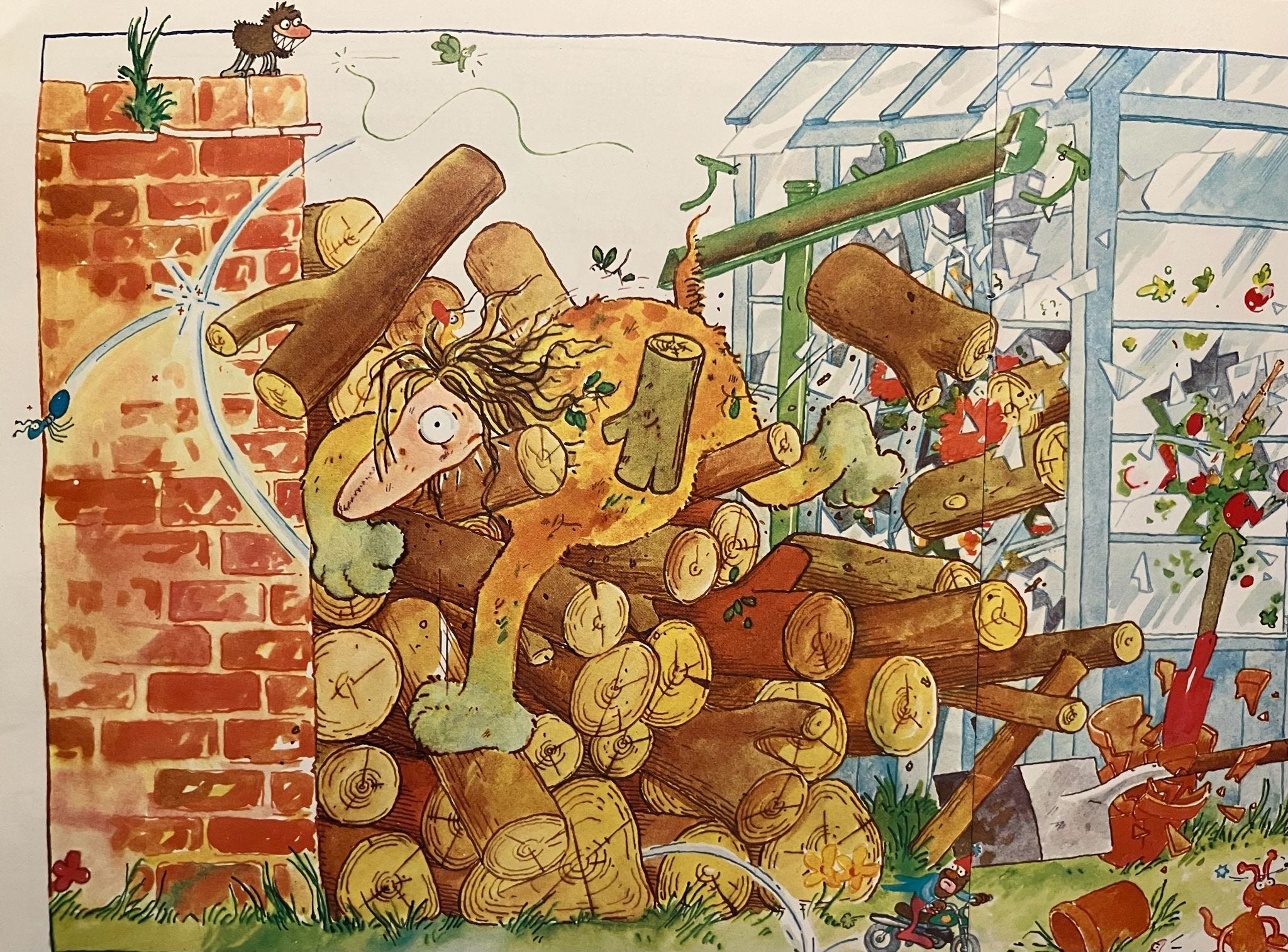
What-a-Mess is Frank Muir’s scruffy puppy. Joseph Wright drew him. Despite his best intentions, What-a-Mess is trouble. One day he decides to do good for a change: he’ll rid the world of ants. Being realistic, he down-sizes his campaign to three ants as a starter. He ends the day with more collateral damage than dead ants. Dane Madore has some new ways to understand how humans make similar mistakes with our own Good Causes.
What we can learn
What can we learn from What-a-Mess The Good? Well he is good. He cares admirably about the world. He wants to turn his broad empathy into helping others by doing good things. He’s realistic enough to focus his empathy and select a more do-able target group. What-a-Mess limits his campaign to rid the world of ants. Then he reduces that to just three ants. Dogs form simple packs; our superior human skill is to organise in groups. Against just three ants, What-a-Mess is happy to go it alone. Even so, the world defeats him. True to form, he messes up.
We can really feel how hard it is to have to compress that overflowing grandiose doing-good, driven by oceanic empathy for everyone, in order to turn it into a much more modest realistic project. Like the puppy, humans also come to realise that hopes and dreams and ideologies have to downsize and squeeze into what one person or a limited campaigning group can actually achieve. Like a fire extinguisher, the grandiose aims and great empathy may still be there inside the smaller project under high pressure. What-a-Mess manages reality quite well as he separates his ideological dreams from his actual one-puppy-sized capacity. And afterwards, he does accept the disappointment of failing.
A great Dane
Many humans and campaigning groups do not manage this as well as What-a-Mess does. Realistically we have to select a particular group to give them our energy and empathy. But the original grandiose desire and empathy can still stay with us. The power of the ideological dreams can still fuel the grandiose Good Cause that we’ve chosen to ride. When we organise into tribal or collective groups, the social pressure sends us into overdrive. Our ideology and our personal identity become fused inseparably in a way What-a-Mess managed to avoid by the end of the day. When the ideology and personal identity fuse strongly it means that no one can say anything without triggering a defensive reaction. That makes the fusion stronger. Like a cult does, or a coercive spouse, or an online bubble of algorithmed confirmation, our normal human social qualities get hyped up to the point that an ideology can reach 100% control of the person’s identity. At that point open minds, evidence-based discussion and debate cannot get a look in.
Don’t forget to distinguish two categories of compliance with coercion:
Those whose minds and lives have been completely taken over into the enthusiastic service of the ideology; and
Those who look much the same but whose minds are privately functioning well. They are scared or realistic about the consequences of not pretending to be compliant. So, for example, a successful, even worldwide cult or culture change may seem to have universal dominance, yet most people privately know what’s really true. The others will either turn out to be right or they too will discover an objective reality sooner or later.
Through his innovative prolific Instagram and other online work, Dane Madore has formulated this thinking further. He helps us see where our grandiosity and collective grandiosity can get tied in with our beliefs and convictions along with our necessarily limited and selective empathy for our chosen Good Cause. On de-fusing ideas he describes and explores how a person’s identity fuses with their beliefs to become what he calls Ideological Identity Fusion (IIF). For IIF you can read: ”hill-I-would-die-on” (for your own Good Cause) or “down-a-rabbit-hole”(for the Good Cause you hate).
You can contribute anonymously to his online IIF research portal to learn more about IIF itself, about your own IIF rating, and to get instant access to the overall results. Dane is generous and open to debates, but needs an income for his work. So some things are paid for. A brilliant little book, Psychocapacity: What the body knows that you were never taught, covers and bridges modern scientific findings with what the human race and its ancient traditions have known far longer. Since our bodies already know, we can learn from this too. He is courageous in the face of the standard online reception as well as of any fair criticism for his professional profile and production line.
How did we get here?
Learning from What-a-Mess and Dane Madore calls for a brief history of the human race in other words. How do we account for our obvious universal human talent for forming and joining passionate groups and campaigns for all manner of good, bad or ugly causes. Good Causes often come into conflict with other groups pursuing their other Good Causes. And that may escalate into passionate often polarising battles to defeat each other even though both Good Causes have valid aims. Conflict may be just through words and media. Or it may entail other tactics to persuade, defeat or silence. The final dreadful strategy we try to avoid is threats, violence and war.
My version of human evolution holds nothing new. It goes like this:
There are 8.3 billion humans on earth. Evolution means each human is designed to prioritise the care and survival of self, family and tribe. Until recent times few people existed in or bothered about larger communities than a village. For many or most, it’s the village that still counts. Tribes would get on OK or compete or fight with other tribes. Now clever humans have grown comforts and a culture of kindness everywhere. Travel, global business and internet encourage us to be inclusive of the whole world as our tribe or village.
But to care for 8.3 billion people as if they were family and neighbours in a village is a monstrously grandiose ambition. It is way more unrealistic than What-a-Mess. Good kind people nevertheless take up global Good Causes (or bad ones) driven by individual and group collective grandiosity, and by as much empathy as group Good Causes fire up.
Like What-a-Mess, we have to moderate our grandiosity and empathy and realistically focus on a smaller cause or needy group to protect, help and save. We switch into a selective empathy that ignores a great many other groups and causes. Our choice of Good Cause is influenced by factors such as the culture or religion we’re born into, or a personal experience or a friend or relative suffering adversity, or just what we now so easily see as it happens on our devices of suffering all around the world. We’re inspired to campaign for our chosen Good Cause.
Being human, tribal and realistic, and given the internet to make it easy, means we can find a few or a lot of other people to join our activist select Good Cause. Maybe the cause gets wide support, funding and success. Sometimes the cause grows into a more ideologically driven force, like crusades and fundamentalist religions can do. Driven to do good, campaigns crusade with selective empathy, fighting any other Good Causes that get in their way. Campaigns may aim to control people’s beliefs, speech and behaviour. Their social media activity too. And ideological or religious conflict can and does go all the way to violence, war and genocide.
Tidying up the mess
To return to Dane Madore’s ideas, the original unrealistic grandiose aspirations are stoked by gathering a kind of tribe around the Good Cause and ourselves. We channel our inevitably limited time and energy into a limited project into which goes our collective grandiosity and selective empathy. Different causes clash with each other.
Those passionate about Good Cause A (who have little empathy for Good Causes B to Z) meet in conflict with those passionate about Good Cause B or Z (who have little empathy for good Cause A). All Good Causes are sure they have valid top priority reasons to be activist; other Good Causes don’t rate as good unless they give way and support our own Good Cause. The valid enough conflict of interests needs to be resolved. Yet the more ideology-identity fusion there is the harder or impossible it is to resolve the conflict.
Examples of clashing Good Causes are not hard to find:
Campaigners for women’s rights have a valid contention with transgender rights activists; and vice versa.
Pro-Palestine anti-genocide campaigners have their contention with those who support the rights of the state of Israel; and vice versa. Here, it seems the key is that the state leaders (Hamas and Likud) both embrace genocidal ambitions that demand the rest of the world pick a side. Vocal activists have done that.
Those happy to welcome immigrants and desperate asylum seekers are in contention with those who would protect national boundaries, culture and resources — including features that are valued by, but might not be sustained by, the incomers; and vice versa.
What do we do about this conflict of Good Causes? Of course all parties need to engage in reasoned, evidenced, discussion and debate. But we’ve seen how people’s “ideological identity fusion” may be too far gone for that. So ordinary discussion won’t work. Compulsory measures don’t work well either in the short or the long run.
It’s a puzzle as, patiently or not, we all try to find a way forward through the mess. And what a mess it seems to be! But and but …
Here’s the kicker!
The kicker is that the vast majority of us are like What-a-Mess. Worse in fact. And in need of his best qualities too.
For each one of the earth’s “village” of 8.3 billion humans there are estimated to be 2.5 million live ants: that’s 20 quadrillion (20 with 15 more zeros). So killing or failing to kill three ants is definitely a waste of What-a-Mess’s day’s work. Before and especially since the world-wide-web and social media got us believing in the global village, humans on their own and in groups have spent far more than one day on their selected Good Cause to change the world. A rare few have teamed up with policy platforms and have helped change the world’s culture and policies. Most of the rest of us have failed to do more than add a ripple or two — although it is true that every ripple helps a wave.
In some families, years have been dedicated to a more private Good Cause aiming to metaphorically “kill off a couple of ants” — or maybe “aunts” or other pesky old relatives who refuse to shut up, lie down and metaphorically “die”. Whether the aim is to change your relatives or change billions or quadrillions of beings, the vast majority of our efforts are a feeble super-grandiose waste of time. Online, the vast majority of published words and music remains untouched — this article included. (But note that my aim here is the realistic “Aim #5: To be seen by a few” not a grandiose changing of the world.) On Spotify, of the music that is successful enough to get in that door, 25% has never been played even once.
When years are spent trying and failing to metaphorically “kill off a couple of aunties”, there’s obviously something else going on than the debating of public policy. We can guess it is fuelled by the grandiose ambition and selective empathy carried into a Good Cause.
Last but not least, killing ants is actually a Very Bad Cause (for the world): it’s not a good one. If What-a-Mess had got together to draw up a policy platform, he’d have discovered that the human race was already well on the way to killing very large populations of ants and insects as collateral to climate change and other clever but noxious human creations. Satirical slogans make serious points: Save the insects! Ants lives matter! Watch your step! What-a-Mess the fascist!
Even so, in the long run, the odds must be on the ants outlasting the humans.
From rough seas to safe harbour
Finally, as a PS, here’s another metaphor that summarises all this neatly. Learning from What-a-Mess was written to help just a few people locked in ideological conflict, eg a family or work group. Another metaphor for being in a pickle in a messy world finds them as the crew of a boat on rough open seas. The sea is the wider world of billions that modern culture and social media pushes us to treat as if it can be our village of “just three”:
We’re a crew in a boat on the open sea being tossed by storms and big waves. We’re disagreeing about where to point the boat. We’re struggling to stay afloat. We need to find safe waters. What’s more, we’ve shipped water from the wider ocean around us. Baling it out is tiring and the day gets darker. Trying to calm the ocean around us is not possible: we’d like to control it, but it’s not in our power. What we can be and must be is a crew teaming up to keep the boat afloat and get back to port. Then we can rest, eat and have fun!!
Back in harbour, our boat would cope with a smaller calmer life, the life of a family and village. It would be like What-a-Mess choosing “only three ants” instead of quadrillions of them. But even three ants was too hard for him: a family in a village is a challenge too. But that’s the size humans are designed for.
The What-a-Mess books were written by Frank Muir with illustrations by Joseph Wright. Currently they’re published under Penguin Random House Children’s UK.